Real honey is a natural substance produced by bees using nectar collected from flowers. Unlike processed or commercial honey, real honey retains all its beneficial enzymes, antioxidants, and nutrients. One defining characteristic is its viscous texture, which can vary depending on the floral source.
Honey is more than just sugar; it’s a complex mix of natural compounds, including amino acids, vitamins, and minerals. Real honey also has antibacterial properties thanks to the hydrogen peroxide naturally present in its composition. Recognizing these traits helps consumers differentiate genuine honey from cheap, adulterated alternatives.
What is Real Honey
Real honey is a natural substance produced by bees using nectar collected from flowers. Unlike processed or commercial honey, real honey is unfiltered, unheated, and unadulterated, preserving all its natural nutrients. It contains enzymes, antioxidants, vitamins, and minerals essential for health.
What is Fake Honey
Fake honey is often adulterated or entirely synthetic, made by mixing real honey with sugar syrup, glucose, or corn syrup. Some products may even contain artificial flavors or coloring agents to mimic the taste of real honey.
What is Commercial Honey
Commercial honey refers to mass-produced honey, typically processed for uniformity, clarity, and long shelf life. Commercial honey is often pasteurized and filtered, removing pollen, enzymes, and other beneficial compounds.
Top Varieties of Pure Honey in Pakistan You Should Try
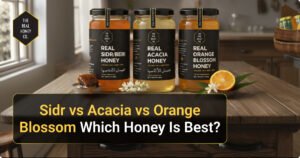
Pakistan’s diverse climate allows bees to collect nectar from some of the finest flowering plants. If you’re looking for real honey with proven purity, these three varieties stand out for their taste, quality, and health benefits.
Real Acacia Honey
Real Acacia Honey is known for its light color, mild sweetness, and smooth texture. It is collected from the blossoms of acacia trees and is one of the most delicate honey varieties available.
This honey stays liquid for a longer time due to its natural fructose content, making it ideal for daily use. Its gentle flavor doesn’t overpower food or drinks, which is why many people prefer it in tea, warm water, or breakfast bowls.
Key characteristics of Real Acacia Honey:
- Light golden to almost transparent color
- Mild, floral taste
- Slow crystallization
- Easy to digest
Real Orange Blossom Honey
Real Orange Blossom Honey is harvested from the nectar of orange tree flowers, giving it a fresh citrus aroma and refreshing taste. This variety is especially popular among those who enjoy lightly flavored honey with a natural fruity note.
It is rich in antioxidants and is often used to relax the body, support digestion, and enhance mood. Its pleasant fragrance makes it perfect for herbal teas, desserts, and natural sweetening.
Key characteristics of Real Orange Blossom Honey:
- Light amber color
- Subtle citrus fragrance
- Smooth and aromatic taste
- Naturally soothing
Real Sidr / Beri Honey
Real Sidr Honey, also known as Beri Honey, is one of the most premium and powerful honey varieties found in Pakistan. It is collected from the flowers of the Sidr (Beri) tree and is highly valued for its medicinal properties.
This honey has a dark golden color, thick texture, and rich taste. It is traditionally used to support immunity, improve strength, and promote overall wellness.
Key characteristics of Real Sidr / Beri Honey:
- Dark golden to amber color
- Thick and dense consistency
- Strong, rich flavor
- High antibacterial properties
Why Choosing Real Honey Matters
Real honey is more than just sweetness. Its benefits include:
- Health Benefits: Supports immunity, improves digestion, and promotes healing
- Nutritional Value: Contains vitamins, minerals, and antioxidants
- Culinary Uses: Enhances flavors, caramelizes naturally, and can preserve foods
Choosing adulterated or fake honey deprives you of these advantages.
Common Adulteration Techniques in Honey
Honey is often adulterated to reduce costs. Common methods include:
- Adding sugar syrups such as glucose or corn syrup
- Artificial coloring or flavoring
- Overheating, which destroys enzymes and antioxidants
Being aware of these practices can help you spot authentic honey.
10 Proven Ways to Test Real Honey at Home
Here are practical tests you can do at home:
1. Water Test
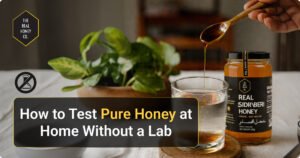
Drop a spoonful of honey into a glass of water. Real honey is dense and viscous, so it sinks slowly to the bottom without dissolving immediately. In contrast, fake or adulterated honey contains added water or sugar syrup and dissolves quickly, dispersing throughout the glass.
Tip: Use a clear glass so you can observe the honey’s behavior clearly. If it disperses immediately, that’s a warning sign. This test is simple but surprisingly effective for identifying most fake honey.
2. Thumb Test
Place a small drop of honey on your thumb. Real honey is thick and sticky, so it will stay in place without spreading. Fake honey, on the other hand, often contains added water or syrup, causing it to spread or drip off your thumb.
This test is ideal for quick verification if you have just a small amount of honey. It’s safe, mess-free, and perfect for home use.
3. Flame Test
Soak the tip of a cotton swab in honey and try to light it with a match or lighter. Pure honey ignites easily due to its low moisture content, while fake or adulterated honey, which often contains water, may fail to burn or produce a sputtering flame.
Safety Tip: Perform this test carefully, away from flammable surfaces, and only with a small amount of honey.
4. Vinegar Test
Mix a spoon of honey with a glass of water and add a few drops of vinegar. If the mixture foams or bubbles, it indicates the presence of added baking soda or chemical adulterants, meaning the honey is likely fake. Pure honey remains stable, showing no reaction.
This test is particularly useful for detecting chemical additives that are not visible to the naked eye.
5. Heat Test
Place a spoonful of honey in a small pan or microwave-safe dish and apply gentle heat. Pure honey will caramelize slowly without producing foam. Fake honey, often mixed with water or syrup, foams, bubbles, or burns unevenly.
This test is a good way to check both purity and natural sugar content. Just make sure to avoid overheating, as even real honey can burn if exposed to high heat.
6. Paper Absorption Test
Drop a small amount of honey onto a paper towel or blotting paper. Pure honey is thick and stays on the surface of the paper, while fake honey spreads and penetrates quickly.
This test is ideal for small quantities and can be combined with the thumb test for better accuracy. It also gives a clear visual clue of the honey’s viscosity and density.
7. Crystallization Test
Observe your honey over time. Real honey tends to crystallize naturally due to its natural sugars. Crystals are small and fine, forming slowly over weeks or months. Fake honey, especially processed or adulterated honey, rarely crystallizes or may form irregular, coarse crystals that indicate additives.
Crystallization is actually a sign of authenticity, not spoilage, and does not affect taste or nutritional value.
8. Taste and Aroma Test
Real honey has a rich, complex flavor that varies depending on the flowers visited by bees. It often has a slightly tangy, floral, or fruity note, with a lingering aftertaste. Fake honey, however, is overly sweet with a flat or artificial flavor and may lack any floral aroma.
Tip: Smell the honey as well; it should carry the natural scent of flowers or nectar, not chemicals or artificial fragrances.
9. Jar and Label Inspection
Check the packaging, labels, and certification marks. Real honey often comes with batch numbers, country of origin, and certification labels like organic or monofloral designations. Avoid jars with vague labels or missing information, as they may indicate low-quality or adulterated products.
Packaging inspection is a simple but effective way to reduce the risk of buying fake honey, especially from supermarkets or online stores.
10. Microscopy Test
For the most precise verification, lab tests can examine honey under a microscope to detect pollen grains. The presence of pollen confirms that the honey is real and derived from flowers. Adulterated honey often lacks pollen or contains unnatural particles.
While not practical at home, this test is widely used by quality control labs and certified brands like The Real Honey Co to ensure authenticity.
Pure vs Fake Honey: Comparison
| Feature | Pure Honey | Fake Honey |
| Taste | Complex, floral, rich | Overly sweet, flat |
| Crystallization | Naturally crystallizes | Rarely crystallizes |
| Nutrients | Full enzymes, antioxidants | Minimal nutrients |
| Water Test | Sinks slowly | Dissolves quickly |
| Price | Higher | Cheaper |
| Aroma | Distinct floral | Artificial or weak |
Best Brand Selling Pure Honey in Pakistan (2026 Guide)
When searching for authentic raw honey in Pakistan, The Real Honey Co stands out:
- Offers 100% pure, unprocessed honey
- Provides certified organic options
- Transparent sourcing from local beekeepers
- Offers a variety of floral-origin honeys
Other brands exist, but The Real Honey Co is widely trusted for quality, authenticity, and traceability.
Where to Buy Pure Honey in Pakistan
- Online Stores: Official website of The Real Honey Co and verified e-commerce platforms
- Farmer’s Markets: Directly from local beekeepers
- Specialty Stores: Organic or health food stores
- Supermarkets: Only from brands with proper certification
How to Store Real Honey Properly
Proper storage ensures longevity and taste:
- Store in airtight glass jars
- Keep at room temperature (20–25°C)
- Avoid direct sunlight
- Prevent moisture exposure
Mistakes to avoid: Refrigeration, sunlight exposure, and plastic containers that can leach chemicals.
The Role of Certification and Labeling
Certifications help identify high-quality honey:
- Organic Certification: Free from pesticides
- Monofloral Honey: Single-flower origin
- Regional Labels: Ensures authenticity and traceability
Proper labeling is a reliable guide for buyers.
Buying Tips for Authentic Raw Honey
- Buy from trusted beekeepers or certified brands
- Check packaging, batch numbers, and certificates
- Prefer small jars for freshness
- Avoid suspiciously cheap options
FAQs About Real Honey
Q1. How can I tell if honey is real without lab tests?
Ans: Home tests like the water test, thumb test, and crystallization observation are effective.
Q2. Does real honey crystallize naturally?
Ans: Yes, crystallization is a sign of pure honey.
Q3. Can real honey help with allergies?
Ans: Raw honey containing local pollen may help reduce seasonal allergies.
Q4. Is processed honey harmful?
Ans: No, but heating and filtering reduce its nutritional benefits.
Q5. How long can real honey last?
Ans: Stored correctly, honey can last indefinitely.
Q6. Is organic honey always real honey?
Ans: Mostly, but always check for certification and origin.
Conclusion
Choosing real honey ensures health, taste, and nutrition. With practical home tests, careful observation, and purchasing from trusted brands like The Real Honey Co, you can enjoy authentic raw honey. Proper storage, certification checks, and awareness of adulteration techniques further guarantee quality.